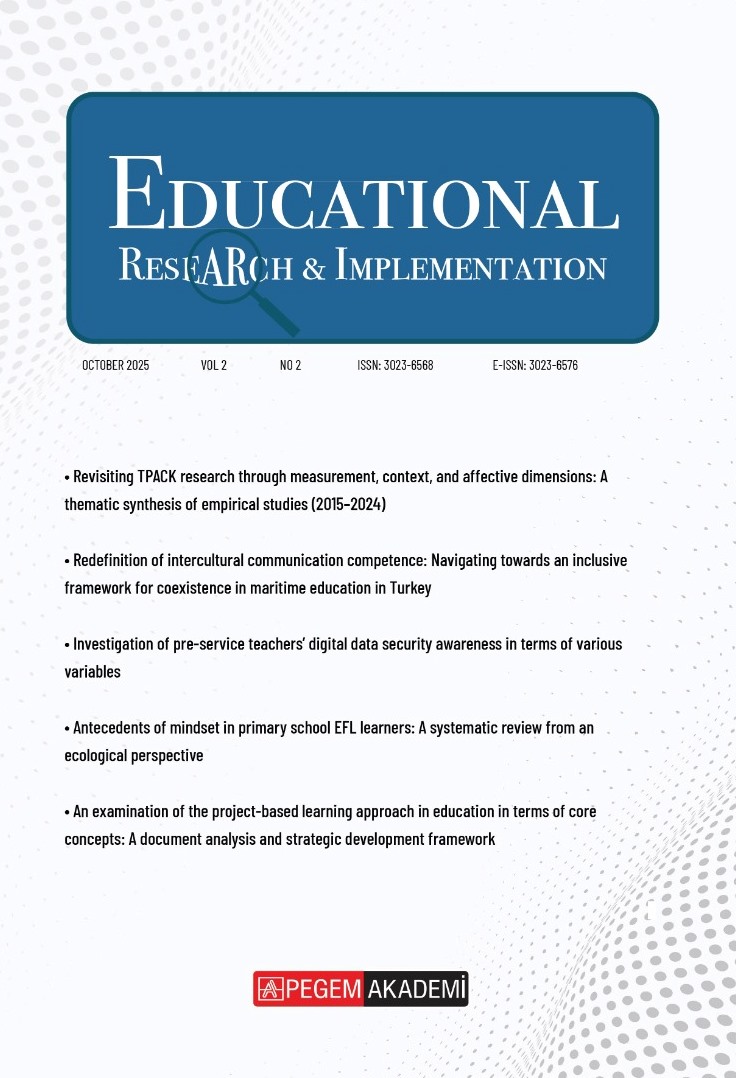
An examination of the project-based learning approach in education in terms of core concepts: A document analysis and strategic development framework
DOI:
https://doi.org/10.14527/edure.2025.10Keywords:
Project-based learning, Document analysis, Project management, Iinstructional designAbstract
This study proposes an evidence-based strategic implementation framework by integrating the theoretical foundations of project-based learning, contemporary design standards, and key managerial requirements that emerge in classroom practice through qualitative document analysis. Peer-reviewed meta-analyses, comprehensive literature reviews, foundational theoretical works, and institutional standards such as the PMI process groups and Gold Standard project-based learning were analyzed thematically. The findings indicate that the risk of reducing project-based learning to the level of isolated activities is closely related to the quality of design elements and instructional guidance. They also show that project management processes, including planning, monitoring, and closure, help reduce cognitive load while strengthening self-regulation and collaboration. In addition, assessment practices, stakeholder participation, digital equity, and ethical considerations emerge as critical parameters that determine implementation quality. By addressing instructional design and project management within a unified framework, the study offers practitioners measurable quality indicators and provides researchers with sets of propositions that can be empirically tested.
Downloads
References
Barron, B., & Darling-Hammond, L. (2008). Teaching for meaningful learning: A review of research on inquiry-based and cooperative learning. George Lucas Educational Foundation.
Bowen, G. A. (2009). Document analysis as a qualitative research method. Qualitative Research Journal, 9(2), 27–40. https://doi.org/10.3316/QRJ0902027
Braun, V., & Clarke, V. (2006). Using thematic analysis in psychology. Qualitative Research in Psychology, 3(2), 77–101. https://doi.org/10.1191/1478088706qp063oa
Condliffe, B., Quint, J., Visher, M. G., Bangser, M., Drohojowska, S., Saco, L., & Nelson, E. (2017). Project-based learning: A literature review. MDRC. https://www.mdrc.org/sites/default/files/Project-Based_Learning-LitRev_Final.pdf
Dewey, J. (1897). My pedagogic creed. School Journal, 54, 77–80.
Dewey, J. (1938). Experience and education. Macmillan. https://doi.org/10.1080/00131728609335764
Hmelo-Silver, C. E., Duncan, R. G., & Chinn, C. A. (2007). Scaffolding and achievement in problem-based and inquiry learning: A response to Kirschner, Sweller, and Clark (2006). Educational Psychologist, 42(2), 99–107. https://doi.org/10.1080/00461520701263368
Kirschner, P. A., Sweller, J., & Clark, R. E. (2006). Why minimal guidance during instruction does not work: An analysis of the failure of constructivist, discovery, problem-based, experiential, and inquiry-based teaching. Educational Psychologist, 41(2), 75–86. https://doi.org/10.1207/s15326985ep4102_1
Krajcik, J. S., & Blumenfeld, P. C. (2006). Project-based learning. In R. K. Sawyer (Ed.), The Cambridge handbook of the learning sciences (pp. 317–333). Cambridge University Press. https://doi.org/10.1017/CBO9780511816833.020
Kwon, H., & Lee, Y. (2025). A meta-analysis of STEM project-based learning on creativity. STEM Education, 5(2), 275–290. https://doi.org/10.3934/steme.2025014
Kilpatrick, W. H. (1918). The project method. Teachers College Record, 19(4), 319–335.
Lincoln, Y. S., & Guba, E. G. (1985). Naturalistic inquiry. Sage.
Mota, F. B., Cabral, B. P., Braga, L. A. M., & Lopes, R. M. (2025). Mapping the global research on project-based learning: A bibliometric and network analysis (2014–2024). Frontiers in Education, 10, 1522694. https://doi.org/10.3389/feduc.2025.1522694
PBLWorks. (2019). Gold Standard PBL: Essential Project Design Elements. https://www.pblworks.org/what-is-pbl/gold-standard-project-design
PMI Educational Foundation. (2025). Project Management Skills for Life®: Educator guide. Project Management Institute. https://www.pmi.org/-/media/pmi/documents/public/pdf/pmief/skills-for-life-educator-guide-english.pdf
Project Management Institute. (2022). Process groups: A practice guide. Project Management Institute.
Sweller, J. (1988). Cognitive load during problem solving: Effects on learning. Cognitive Science, 12(2), 257–285. https://doi.org/10.1207/s15516709cog1202_4
Thomas, J. W. (2000). A review of research on project-based learning. Autodesk Foundation.
UNESCO. (2015). Education 2030: Incheon Declaration and Framework for Action for the implementation of Sustainable Development Goal 4. UNESCO.
van Dijk, J. (2020). The digital divide. Polity.
Vygotsky, L. S. (1978). Mind in society: The development of higher psychological processes. Harvard University Press.
Wood, D., Bruner, J. S., & Ross, G. (1976). The role of tutoring in problem solving. Journal of Child Psychology and Psychiatry, 17(2), 89–100. https://doi.org/10.1111/j.1469-7610.1976.tb00381.x
Zhang, L., & Ma, Y. (2023). A study of the impact of project-based learning on student learning effects: A meta-analysis study. Frontiers in Psychology, 14, 1202728. https://doi.org/10.3389/fpsyg.2023.1202728
Downloads
Published
Issue
Section
License
Copyright (c) 2025 Educational Research & Implementation

This work is licensed under a Creative Commons Attribution-NonCommercial-NoDerivatives 4.0 International License.
This license enables reusers to copy and distribute the material in any medium or format in unadapted form only, for noncommercial purposes only, and only so long as attribution is given to the creator. CC BY-NC-ND includes the following elements: Credit must be given to the creator; only noncommercial uses of the work are permitted; no derivatives or adaptations of the work are permitted.


