From the Editor in Chief
DOI:
https://doi.org/10.14527/Keywords:
EditorialAbstract
Dear producers and consumers of knowledge,
It is with great pleasure that I welcome you to Volume 2, Issue 2 of Educational Research & Implementation (EDURE). As a journal dedicated to advancing scholarly dialogue and educational practice, EDURE continues to grow in both quality and academic visibility. Although only a relatively short time has passed since the publication of our first volume, we are encouraged by the increasing interest in our journal and by the citations our articles have begun to receive in national and international studies.
In line with our commitment to academic rigor, we continue to adopt a highly selective editorial policy beginning with the initial submission stage. We kindly encourage prospective authors to carefully review the Author Guidelines prior to submission. All manuscripts are screened using iThenticate to ensure originality, followed by an initial editorial evaluation that is typically completed within five days. Our peer-review process is conducted with diligence and transparency, and we aim to finalize reviews within an average period of approximately three months.
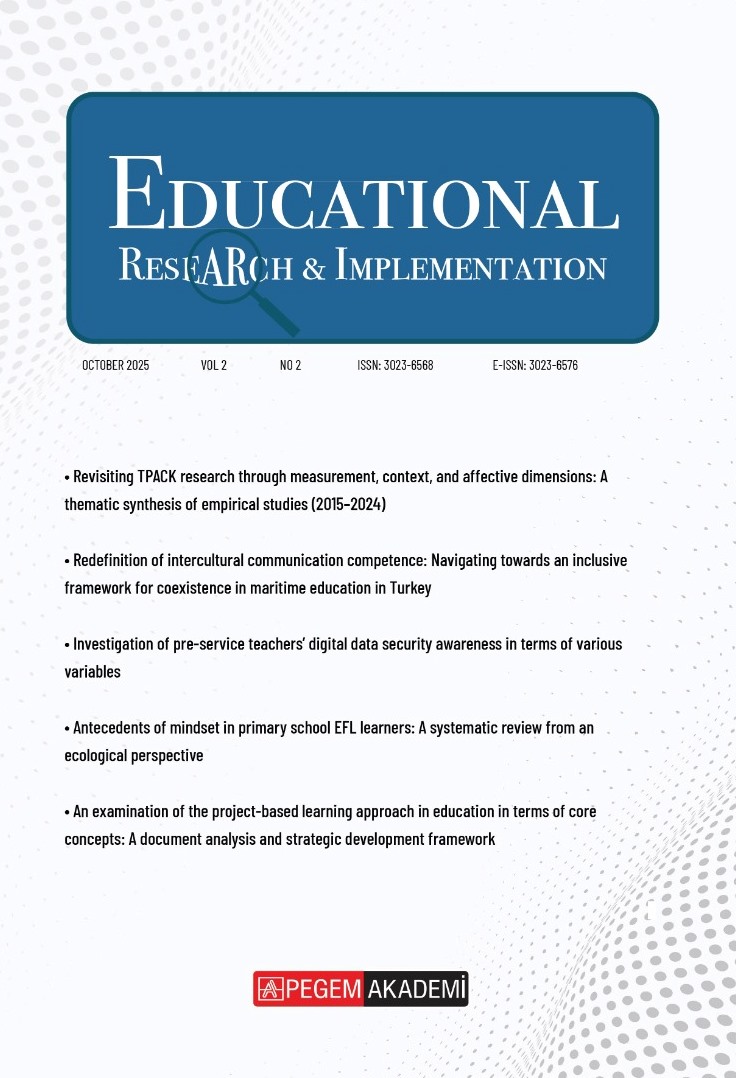
The present issue brings together five articles that collectively address contemporary challenges in education through diverse theoretical lenses, methodological approaches, and educational contexts.
The first article, titled “Revisiting TPACK research through measurement, context, and affective dimensions: A thematic synthesis of empirical studies (2015–2024)” by Seyfettin Dakın, offers a comprehensive systematic review of 94 empirical studies on Technological Pedagogical Content Knowledge (TPACK). By integrating measurement approaches, contextual conditions, and affective variables within a single analytical framework, the study reveals that reported TPACK gains are often shaped by methodological choices rather than serving as direct indicators of classroom transformation. This critical synthesis provides an explanatory evidence map that clarifies longstanding contradictions in the TPACK literature and offers actionable implications for teacher education and future research.
The second article, “Redefinition of intercultural communication competence: Navigating towards an inclusive framework for coexistence in maritime education in Turkey” by Çiğdem Kurt, explores intercultural communication competence (ICC) through the perspectives of students in maritime higher vocational education. Using a qualitative case study design, the research reframes ICC as a political and ethical tool for inclusive coexistence in multicultural professional contexts. The findings underscore the importance of preparing future maritime professionals not only as technical experts but also as intercultural speakers, mediators, and negotiators capable of fostering dialogue and equity.
The third article, authored by Mehmet Emre Sezgin and Sevda Uğuz and entitled “Investigation of pre-service teachers’ digital data security awareness in terms of various variables,” examines pre-service teachers’ awareness of digital data security in contemporary educational environments. The study indicates that awareness levels are generally above moderate and vary significantly by grade level and academic department, though not by gender. The findings highlight the urgent need to integrate digital data security, privacy, and information ethics as systematic components of teacher education curricula.
The fourth article, “Antecedents of mindset in primary school EFL learners: A systematic review from an ecological perspective” by Özge Doğan and Sibel Güzel Yüce, shifts the focus of mindset research from outcomes to origins. Synthesizing 31 empirical studies, the authors demonstrate that growth and fixed mindsets in young EFL learners are shaped by a complex ecological system involving teachers, families, peers, and individual learning experiences. By adopting an ecological framework, the study offers important insights for early language education and calls for holistic, ecosystem-oriented interventions.
The fifth and final article of this issue, “An examination of the project-based learning approach in education in terms of core concepts: A document analysis and strategic development framework” by Hasan Taşay and Mustafa Çelebi, presents an evidence-based framework that integrates instructional design principles with project management processes. Through a thematic document analysis, the study emphasizes that the effectiveness of project-based learning depends largely on design quality, guidance, assessment practices, and systematic management. The proposed framework offers both practitioners and researchers concrete quality indicators and testable propositions for sustainable implementation.
I sincerely hope that the studies presented in this issue will contribute meaningfully to both educational practice and theoretical advancement across diverse fields of education. I would like to extend my heartfelt gratitude to our authors, editors, and reviewers whose dedication and scholarly rigor have made this issue possible.
I look forward to meeting you again in our next issue and wish you an inspiring and productive reading experience.
With my warmest regards,
Downloads
References
.
Downloads
Published
Issue
Section
License
Copyright (c) 2025 The Author(s)

This work is licensed under a Creative Commons Attribution-NonCommercial-NoDerivatives 4.0 International License.
Authors retain copyright in their articles. Authors grant EduRE and its publisher, Pegem Akademi, a worldwide, perpetual, irrevocable, non-exclusive right to publish, reproduce, distribute, archive, communicate, and identify EduRE as the original publisher of the Version of Record. All articles are published under the Creative Commons Attribution-NonCommercial-NoDerivatives 4.0 International (CC BY-NC-ND 4.0) license.


